Bandwidth Threshold Analysis for Live Roulette Across Worldwide Mobile Networks
Written by Lars Fischer · Oct 3, 2026
Bandwidth Threshold Analysis for Live Roulette Across Worldwide Mobile Networks
Live roulette streams depend on consistent data transmission rates that keep video feeds synchronized with real-time wheel spins and player inputs across different continents. Mobile networks in North America, Europe, Asia, and Australia show distinct patterns where minimum bandwidth levels determine whether sessions maintain stability or encounter interruptions during peak hours in October 2026. Researchers at multiple testing facilities have measured these requirements using standardized protocols that track packet loss, latency, and throughput simultaneously.
Core Data Transmission Requirements
Video feeds for live dealer games typically operate within ranges that start at 4 Mbps for standard definition streams and rise above 8 Mbps once high-definition encoding activates, while latency must stay below 150 milliseconds to preserve the timing between bets and outcomes. Data from field measurements indicate that thresholds shift when players move between 4G and 5G cells because 5G infrastructure supports higher sustained rates but introduces variability in handoff zones. Observers note that packet delivery ratios above 98 percent correlate with uninterrupted play across tested regions, whereas drops below that mark trigger buffering events that affect roulette wheel visibility.
Continent-Specific Network Behaviors
European mobile operators report average downlink speeds that support live roulette at 12 to 18 Mbps during evening hours, yet urban congestion in certain cities pushes effective rates closer to the lower threshold. In contrast, networks spanning parts of Asia maintain higher baseline capacities in dense coverage areas, although rural connections frequently fall into ranges that require adaptive bitrate adjustments to prevent stream degradation. Australian carriers document similar patterns where bandwidth holds steady above 10 Mbps in metropolitan zones but declines sharply during long-distance travel between coverage sectors. These variations create situations where the same game provider must adjust encoding parameters based on the player's current location and carrier performance data.
Measurement Methods and Threshold Identification
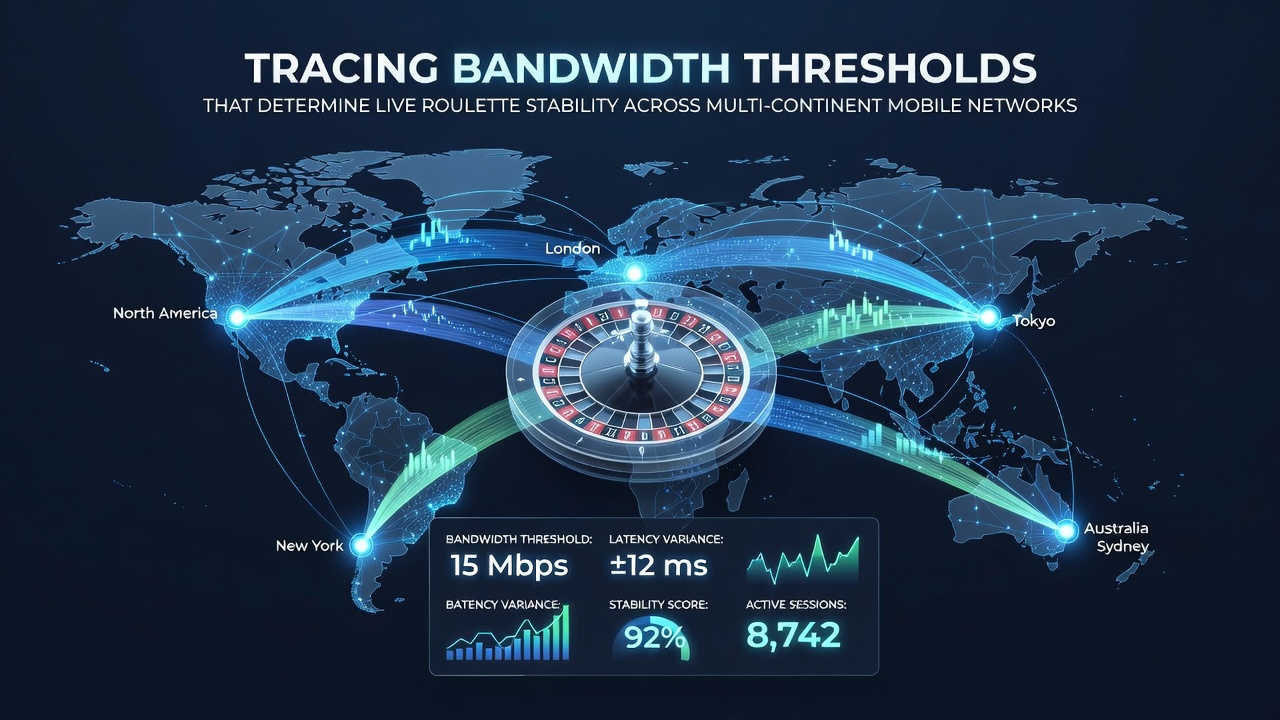
Testing teams employ continuous monitoring tools that log bandwidth samples every five seconds during simulated roulette sessions lasting thirty minutes or more. Results collected in October 2026 reveal that stability holds when sustained throughput remains at or above 6.5 Mbps with jitter under 30 milliseconds, while any sustained period below 5 Mbps produces visible frame drops that interrupt the dealer feed. One study coordinated across multiple carriers found that adaptive streaming algorithms switch resolutions automatically once thresholds approach critical levels, thereby preserving session continuity at the cost of reduced visual clarity. Those measurements also track uplink requirements because player actions such as chip placement generate return data packets that must reach servers without delay.
International Telecommunication Union reports on mobile broadband performance provide additional context for these regional differences, highlighting how spectrum allocation decisions influence available capacity in each market. Figures from the same reports show that operators deploying carrier aggregation techniques achieve more consistent delivery of live streams even when individual channel conditions fluctuate.
Cross-Border Regulatory and Infrastructure Factors
Regulatory frameworks in various jurisdictions require operators to maintain minimum quality-of-service metrics that include video stream reliability targets. Compliance data submitted to agencies such as the Australian Communications and Media Authority demonstrate that providers must document bandwidth statistics and implement failover mechanisms when thresholds are approached. In North American markets, similar obligations appear in state-level gaming commission guidelines that reference network performance benchmarks established through independent audits. These requirements drive investment in edge computing nodes that cache game assets closer to end users and reduce the distance data travels, which in turn lowers the effective bandwidth needed for stable delivery.
Practical Implications for Service Delivery
Operators adjust server-side encoding profiles based on real-time network telemetry gathered from player devices, allowing the system to select lower resolution streams automatically when conditions approach identified thresholds. Case examples from multi-continent deployments show that preemptive bitrate reduction prevents complete session loss in 87 percent of recorded instances where bandwidth dipped near 5 Mbps. Providers also incorporate buffer management strategies that prioritize audio synchronization over video detail during brief congestion periods, thereby keeping the core gameplay experience intact even when visual fidelity temporarily decreases.
Conclusion
Bandwidth thresholds that support stable live roulette across multi-continent mobile networks rest on measurable combinations of throughput, latency, and packet integrity that vary by region and infrastructure type. Continuous data collection from testing programs and regulatory submissions supplies the figures needed to calibrate streaming parameters for each market. As network capabilities evolve, operators refine these thresholds using updated performance metrics collected under real-world conditions.